Book Review – 26 Marathons

Book Review – 26 Marathons

By Meb Keflezighi (With Scott Douglas)
Reviewed by Coach Adolfo Salgueiro

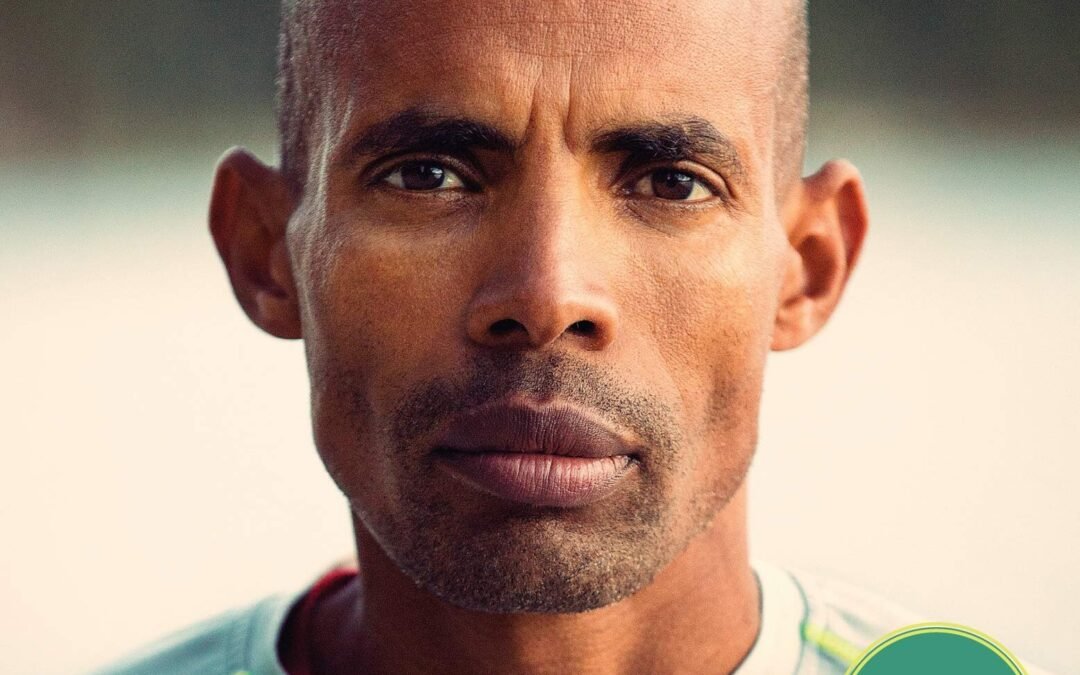
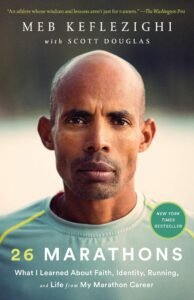
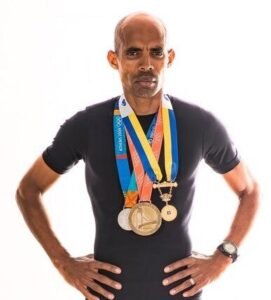
 When we talk about the top US marathoners in the United States during the first fifth of the 20th Century, the name of Meb Keflezighi automatically jumps to the forefront. If you don’t consider him at the top of the list, which you are entitled to, it seems difficult he won’t be on your Top-3 or Top-5. He is the only runner to ever win Boston, New York and earn an Olympic medal. And even though he only won 3 of his 26 career marathons (hence the name of the book), his personality, constant top-level performances and contagious smile, made him an icon on the world stage between 2002-2017.

26 Marathons


A good book, well written and worth the time and the money

In his latest book, Keflezighi goes into detail about each one his 26 marathons. How he trained, what were his life challenges at the time, how he performed and the sports and life lessons he took from each one of them. He enjoys and doesn’t shy away from the glory of his successes, yet at the same time makes himself vulnerable by taking us through his failures and how to deal with them when you are expected to perform at a certain level and you just can’t.

This is a short book, about 250 pages, and a very pleasant read. Succinct chapters allow you to soak in a marathon or two in each sitting, without being overwhelmed by excessive details.

At times it becomes difficult to relate to Meb’s running experiences because 99.9% of runners will never need to ponder if we are ready to respond to Eliud Kipchoge’s surge in the Olympics or how to prepare for what may come to us in the last 10K of the New York City Marathon when you enter First Avenue as part of the leading pack. But that doesn’t matter. We read books about great baseball or football players though we will never be on the field with them at the next World Series or Super Bowl. Meb’s tales from the front are well told and through his words, he does bring us with him to that place we will only see when we are watching a race on TV.

The book is geared towards life lessons on planning, patience, adjustment to goals, change of expectations made on the fly and many other subjects that mean something to us when they come from first-hand experiences from a world-class athlete who has been there not one, but many times.

A leitmotif for Meb’s career was his spouse’s support. He doesn’t hide that his wife, Yordanos, was the family’s backbone that permitted him to achieve his goals. As runners, we all need the support of our wives, husbands or significant-others to achieve what we are looking for, and the Keflezighis show us how.

26 Marathons

Only athlete ever to win Boston, New York and an Olympic medal

I loved Meb’s conclusion about his career as a marathoner. We may not be able to relate to some of his tales from the leading pack, but everyone who has completed multiple marathons, somehow will see himself/herself in this:

“I did twenty-six marathons over fifteen years, one for each mile of the race. I learned that the marathon can hate you or love you. It can make you go though misery or experience great joy. I learned that no matter what it happens, eventually you’ll look back and think, ‘That was a beautiful thing. I’m glad I did it.”

If you want to know more about Meb’s personal life, his childhood in Eritrea, move to the United States, life and career, “Run to Win” is your book. “26 marathons” is a good book, well written and worth the time and the money you will spend on it. But I do think it is important to understand what the book is and what it is not, before you tackle it, so you can be in the right frame of mind when you read it and thus, get the most out of it.

If anyone knows or has access to Meb, please thank him on my behalf for both books and for being an inspiration to the running community throughout his long career. His name is up there with Alberto Salazar, Bill Rodgers, Frank Shorter, Ryan Hall, Clarence De Mar, etc. in the pantheon of great US runners of all time.


My Virtual NYC Marathon of 2020

My Virtual NYC Marathon of 2020

By Coach Adolfo Salgueiro

When the New York City Marathon decided to go virtual, I received an invitation to participate in it, not sure why since I did not register even for the lottery. I had no interest. Why would I do a virtual New York when I’ve done it in person twice and it is one of the most amazing running experiences, ever? But the more I thought about it, having a 26.2 on my schedule would give me a tangible goal that, otherwise, there is no chance I would even get close to.

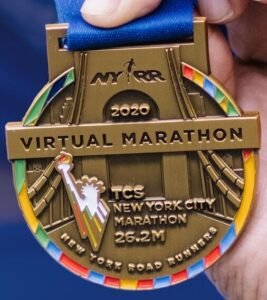
Virtual Marathon

A beautiful addition to the collection that I should be getting soon. This will commemorate my 10th Marathon

Sixty dollars was an affordable price, and a spectacular medal a welcomed incentive. Not sure what else is included, but it is irrelevant. You had between October 17 and November 1 to complete the 26.2. This was just between 8 and 10 weeks away depending on the date I ran it. I settled for October 24th so I could have an extra week of training and a spare one should anything go wrong.

Because of an injury some and health issues I went through last year, I hadn’t run more than 10 kilometers straight during the year. I had gone longer when including walking breaks. Run/walk intervals allowed me to get my fitness and aerobic capacity back. I also had to shed a few extra pounds. So I prepared a NYC plan focusing on steady increment of mileage, management of effort and heart rate control based on full recovery. Finishing time for this one was a secondary consideration. Finishing strong and without injury was more than enough reward.

My plan called for a few running miles at the start and from there on, run half mile and walk another half. Yes, a lot of walking, but I didn’t want to get my heart rate so high that that it would become unsustainable and force me to walk the last 10 miles. As I trained and was able to run more miles, I felt the recovery periods were way too long, so I adjusted. My longest training session was 17 miles, my longest non-stop run was 9 miles. My run/walk intervals got set to .6/.4. I was ready to go.

Virtual Marathon

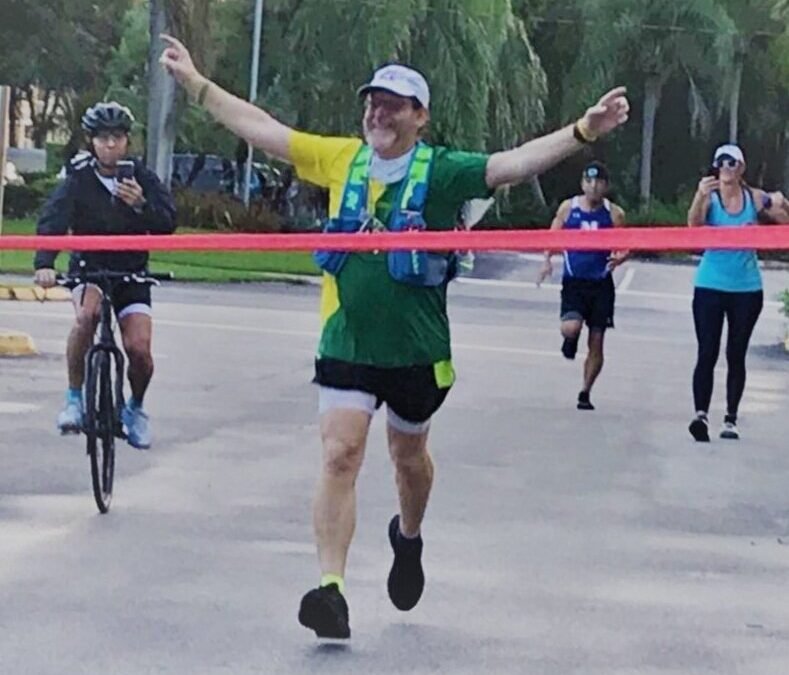
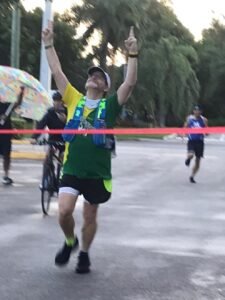
Thanking God as I cross the finish line, surrounded by my running family.

Then, October 24th, 2020 arrived and at 2:26AM I hit the road. I ran the first 6 miles and met with Bill and Rita about 3:30 am for my first water and resupply stop. From there on, I started my run/walk protocol. At first it bothered me to walk when I still felt strong, but I knew it was an investment towards the last miles, and it paid off. At mile 10, I met up with Ted, who accompanied me the next 8 miles. Up to this point my wife followed me in the car, so slow that a cop found it suspicious enough to stop her.

Close to Mile 17, the most amazing thing happened. A caravan of my running buddies passed by with horns, cowbells, yelling and screaming. A shot of adrenaline invaded my body. They were going to our regular Saturday starting spot, where I met them to pick up my last supply cache from Patrick. Once there, I kept going for my last 8.2 miles with a few friends here and there. Ruben stuck with me and ran/walked with me the whole way, sacrificing his training for the day.

I may have missed then entrance to First Avenue from the Queensboro Bridge, but what my buddies from the No-Club Runners had at the finish line was equally impressive. I choked as I ran towards the line through a tunnel of screaming, yelling, cowbells, paparazzi and the support of those who were genuinely elated to share this moment with me. It was not Central Park, but I wouldn’t trade this finish line for it.

Final time accepted by NYRRC was 5:28:14. Almost two minutes below my wildest expectations.

Virtual Marathon

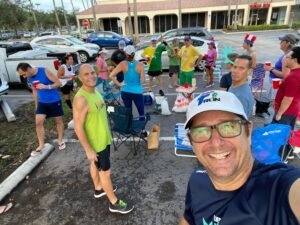
Post-marathon celebration with my buddies from the No-Club Runners. What an amazing bunch of people.

I have been asked if I count this experience as a completed marathon. If I count it as my 3rd time completing NYC? The answer to both questions is yes. The answers are affirmative because this was an established and scheduled race. It did not happen this year because of Covid. This is not a race that popped up to sell you a medal taking advantage of the pandemic. There was a strict time frame on when to do complete the specific distance. This was not a “run what you want, when you want” scheme. On a personal level, it is not like I’ve ran 26.2 so often that I lost count. This is just my 10th time at the distance.

This experience taught me is that I am mentally stronger than I thought. That if I am smart about how to approach certain challenges, adjusting as I work towards them, I can achieve and complete them successfully and safely. That the marathon is still a great adversary, but no unconquerable. And, above all, that I have a running family for which superlative adjectives to qualify them would make no justice to what they mean to me.

The Medal Collection is Finally Complete

The Medal Collection is Finally Complete

By Coach Adolfo Salgueiro

 In today’s blogpost I am going to go personal, as something super cool just happened to me a couple of weeks ago. So cool, that I am still trying to figure out if it actually happened. Well, I wouldn’t go that far, but amazing, nevertheless.

As many of my friends know, as well as readers who have taken the time to read My Running Story page in my website, I started running when I was very young. At 17 I ran my very first marathon. That race was an amazing experience that, almost four decades later, I still cherish and one of the coolest ones from my teenage years. There are not many high schoolers with a full marathon under their soles.

Medal Collection

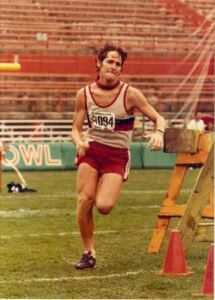
At 17, a senior in high school, and just a few yards away of finishing my very first full marathon

On January 22nd, 1983, my dad and I lined up at the foot of the old Orange Bowl Stadium for a 7AM start of the Orange Bowl Marathon. I remember a humid and rainy day in Miami and Bill Rodgers as the favorite to win. Our plan was to run the first 35K (about 22 miles) together and then every man was on his own. We cross paths with Rodgers twice during in-an-outs at Coral Way and Coconut Grove. Then, at mile 22 my dad left me in the dust and finished in 3:55. After walking a few painful and humbling miles, I triumphally crossed the finish line in 4:11:11. What a thrill to fall on my dad’s arms a few feet after and ask him: “When do we do this again”. But I digress.

The point of this story is that back in 1983, getting a medal worth its place in an art gallery was not the norm. New York was famous for handing medals to every finisher. My dad had one from the previous year. The Orange Bowl offered medals to the first 500 or 1000 finishers, I don’t recall precisely. What I do recall is that I did not get one. I have finished eight more marathons and despite some beautiful medals to represent my achievements, there was always a hole in my collection. A hole that may never be filled.

Until now.

On September 2, I was at my computer and for some reason the thought of the 1983 Orange Bowl Marathon and my lack of medal, crossed my mind. So I did a Google search and, to my most absolute astonishing surprise, there was one for sale in eBay for $15.99 plus $2 for shipping. I could not believe my eyes. The elusive medal was somewhere out there. I have never even seen one. But from my race shirt I recognized the logo and that was it. Just a few clicks away. Calling my name. Winking at me. I could not let the opportunity go. I purchased it right away.

The times I thought about the missing piece in my collection, I entertained finding a nice shell in the beach, hang it in a string, and call it my Orange Bowl 1983 memento. But it never went beyond a passing thought. The absence in the collection persisted.

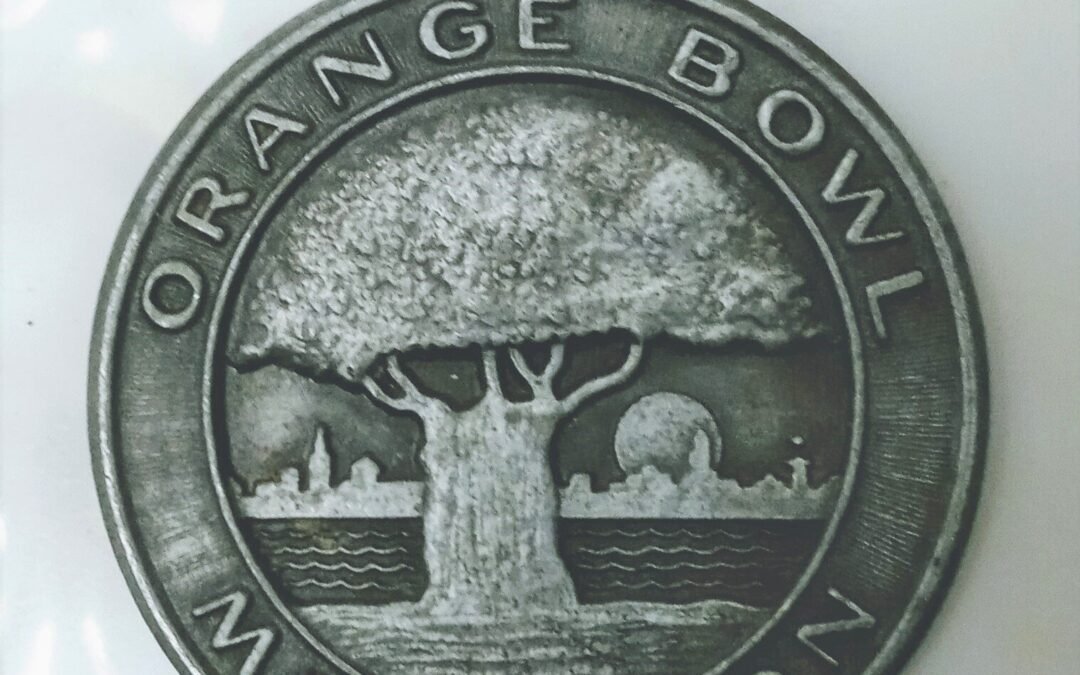
On September 9, 2020, 37 years, 7 months, and 18 days after I crossed the line of my first marathon, the package arrived. I finally had the medal in my hands. A plain, cheap, worn out piece of metal. Maybe an inch and a half in diameter and not even attached to a string or lace. Not the prettiest puppy in the litter, but MY medal. The representation of MY achievement on that day, from when I was still a senior in high school.

This medal doesn’t fill a hole in my soul, just a hole in my medal collection. With nine marathon finishes I have done better times, travel to other states and countries, ran in some of the biggest races in the world, and accumulated countless stories. How I got my medal 13,746 days later, has just been added to the memories.

The Journey of a Six-Star Finisher

The Journey of a Six-Star Finisher

By Starr Davis

Editorial note: Last week we talked about the Abbott World Marathon Majors Series. This week, my friend Starr Davis tells her account of achieving the milestone despite some physical problems she encountered along her journey.

For me, 2018 was the year of comebacks. In October 2017, I began having hip issues. Surgery was recommended to remove a bone spur and repair/replace the labrum. My surgeon and I decided because I had amazing marathons ahead of me, we would postpone surgery until after I finished them. Then, he would be able to repair any additional damage. We weren’t sure if this would end my running career. From October through December 2017, I ran the Chicago, Marine Corps, Berlin and Havana marathons, plus a 50K Ultra Marathon.

Six-Star Finisher

Starr at the iconic finish line of the Berlin Marathon.

Still postponing surgery, in April 2018, I was able to complete both the Boston and London Marathons. Boston was a challenge as temperatures were in the 30’s with constant rain.  I wound up in 11 medical tents with hypothermia symptoms. However, because I had raised $6500 for charity from friends and I knew this was my one opportunity to do Boston, I finished the race.

Six days later, I ran the London marathon. The temperature was in the 80s. Between the contrast in weather and my hip, I wound up walking the marathon from mile 8. But I was totally overjoyed to complete two races in 6 days.

Three weeks later, I had hip surgery. I was truly fortunate that it was not as major as anticipated—the labrum wasn’t torn but had a bone spur sticking out of it that was labor intensive to remove. Of course, when I woke up, my first question was “when can I run?” I had been offered a sponsorship race entry to the NYC Marathon in November, and I really wanted to do it. I was told that running it would be impossible, but I should be able to walk it.

Six-Star Finisher

Receiving the coveted Six Starr medal after finishing Tokyo in 2019

Twenty-four weeks after surgery, I was able to walk the NYC marathon. My body had done so much better than I expected. There were hours and hours of therapy and minimal training. I feel so blessed to have been able to have the “perfect” conditions. I was joking with doctors that Boston was too cold and wet; London was too hot and finally, New York was “just right.” He has now nicknamed me “Goldilocks.”

I ran the Tokyo Marathon just March 3rd of this year, and it was epic, albeit miserable race conditions. It was 43 degrees with constant rain—but it was 8 degrees warmer than Boston and rain was coming straight down instead of at an angle.

Let’s focus on the good things. After Tokyo, I became an Abbott World Marathon Majors Six Star Finisher. What does that mean?  I am one of 4,989 people in the world who have successfully completed the six major world marathons: Berlin, Chicago, New York, Boston, London and Tokyo.  Of these finishers, 1,376 are women and 929 are from the USA.  I’m so over the moon that I was able to successfully complete this, especially as a 50-year old who overcame crazy health challenges.

That stretch of 19 months of running was amazing for me—they’ve given me the opportunity to meet amazing new people, travel to great locations and most importantly, change my attitude of what can be accomplished. I have changed my eating habits and developed a better relationship with myself. It’s amazing what running some miles can do for you.

Starr Davis is a lifelong educator who has a passion for helping others grow in their career. She earned the coveted Six-Starr medal in 2019. She lives in South Florida and is a newly retired marathon runner.

The Abbott World Marathon Majors Series

The Abbott World Marathon Majors Series

By Coach Adolfo Salgueiro

Most of my readers may already know about the Abbott World Marathon Majors Series. After all, if you are reading this, most likely you are a runner and may have even completed at least one of the races, if not more. But for those who don’t know about it, or just would like to refresh their knowledge on the subject, I am hereby writing this quick blogpost.

The Abbott World Marathon Majors was established in 2006 with the five, highest-profile races in the globe: New York City, Berlin, Boston, London, Chicago, Then, in 2013, the Tokyo Marathon was added. It is a championship-style group of races in which the Marathon World Championship is awarded. Each series consists on seven races, starting and ending with the same race and then moving on to the next one. The series also includes the Olympic Marathon and the IAAF World Championship on the years those take place. The last completed series was the XII, which started in Berlin 2018 and finished in Berlin 2019. Series XIII has been crippled by Boston going virtual, Berlin and New York cancelled, and London hanging by a thread. Not sure what will the World Marathon majors do about it.

Abbott World Marathon Majors

Abbott Laboratories is the title sponsor for the World Marathon Majors Series

The 12 Abbott World Marathon Major Series have been won 11 times by a Kenyan and one by an Ethiopian on the men’s side, and 8 times by a Kenyan, three by a German and one by and Ethiopian on a Women’s side. The current champions are Eliud Kipchoge and his compatriot Brigid Kosegi on the female side. Five runners have won more than one series, with Kipchoge leading the way with four.

But 99.9% of the runners will never, ever get close to scoring a single point on the Abbott World Marathon Major rankings, so what is it in it for them? Abbott has developed a successful marketing campaign in which by crossing the line of any of their runs, you earn what is known as “a star”. Once you complete all six, then you earn the “The Six-Star Medal”, a commemorative piece to memorialize your cumulative achievement. It is one of the most coveted medals in the sport, since it is something you can’t purchase, and it requires an immense investment of time, effort, and money.

Obtaining the Six-Star medal is not about just having the resources to travel to all six destinations or being physically able to complete six marathons. Marathoning has become so popular in the last decade and the Abbott World Marathon Major Series has become so big, that securing a spot in the races is usually the first obstacle for may runners. For Boston you need to qualify and only the faster times get to the starting line, unless you raise funds for charity, which has challenges of its own. London is extremely popular and hitting that lottery could be as difficult as hitting the Power Ball. For New York, Tokyo and Chicago, there are usually over 100 wanna-runs for each spot available. It is said the “easiest” lottery to hit is Berlin, but if that is the perception, more and more runners will gravitate towards that one, making it tougher to hit a spot.

Having earned the Six-Star medal usually makes you a celebrity in your local running community. Fellow runners want to take pictures with you and your medals. It is a cool think to have in your hand. A friend of mine got hers and brought it to our local running store. You feel like you are holding an Olympic medal. It is that cool.

Next week I will post the experience of an actual Six-Star Medal member, Starr Davis, who overcame a series of physical obstacles to earn her medal. Hopefully, you will earn yours, soon and tell us all about it.

For more information on the Abbott World Marathon Majors Series, visit their website by clicking here.

Abbott World Marathon Majors

These are the six World Marathon Majors. How many Stars do you have so far?

Skip to content